
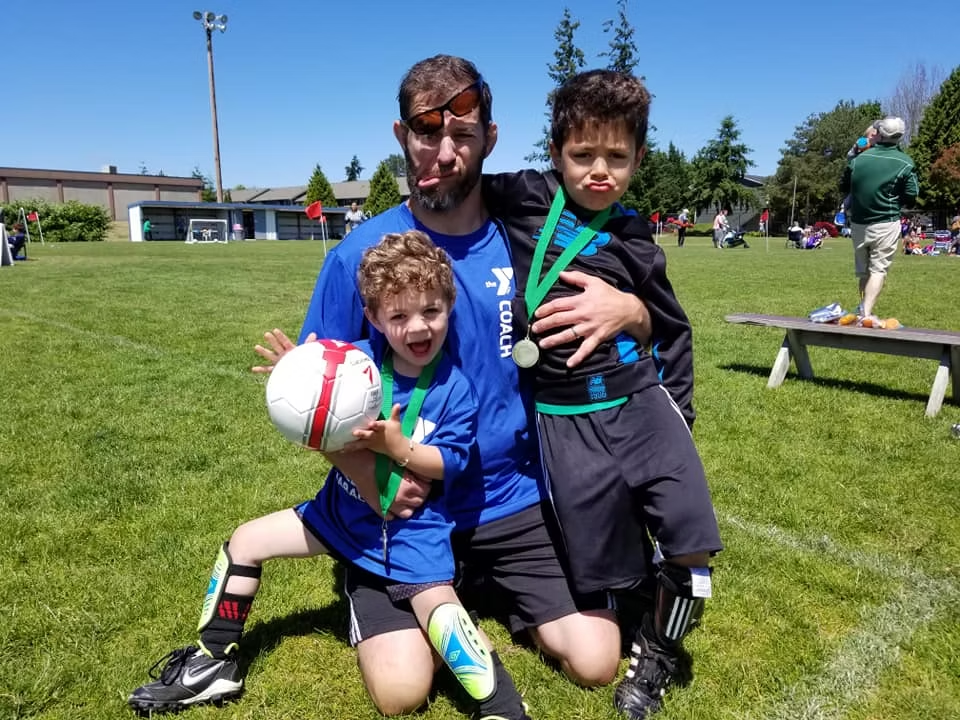
All the kids are lined up on the chalk line ready for jumping jacks, and one kid lies in a heap at the end of the line. Most of the kids do a resemblance of a jumping jack and the heap kid stands up, jumps straight up, and falls back down to assume the pile position. The coach has the kids turn and run around the soccer field, staying on the boundary line. The kid pile catches up to the last kid and trips into her. He stops to pick up grass, trips over the cones, and sits down to pick up more. The other 6-7-year-olds are not light years ahead in executing this exercise, but eventually the cats are herded back to the beginning in the original positions. The last kid again sees everyone lining up and runs full speed into everybody, receiving a spare in kid bowling. Next, the kids stand in a close line and take turns kicking into the goal. The bowler in the back of the line decides to put his entire body right up against the girl in front of him. This sets off a chain reaction of something resembling cars in traffic getting rear-ended. Kids yell, some laugh, most fall down. For the rest of practice, this same kid is redirected, talked to, told off by the other kids, redirected again, rolled in the grass, told off by the other kids, talked to again, and redirected a few more dozen times. In lines, he often sits down. During drills, he does them incorrectly. He kicks the ball too hard. He kicks the ball too softly. He is constantly too close to everyone or on the other side of the field. When the ball comes to him, he is busy looking at the birds or the grass or the sun or staring at his own hands. And when practice is all done, the snacks are handed out, and they are safely in the car, this same kid either passes out into the land of nod or is dragged to the car screaming and crying. In which case, it makes it hard to give them the ice cream you promised them for going to practice in the first place.
I’ve been dealing with this kid my whole life. This kid was me when I was a kid (despite what my wife says, I am now a grown-up). This kid is now my own kid whom I spend a majority of my life redirecting. And this kid is on every team I coach. We are the kids that struggle with attention. We struggle with following directions. We struggle with motor planning. We struggle with filtering out the ladybug that is way more important than the fly ball hit in left field where our kind is usually put. We are the sensory kids.
Without getting too deep, when I refer to sensory kids during recreational sports and activities, I refer to the following things:
1. Sensory kids have difficulty PROCESSING input. So when the coach says to kick the ball twelve times before the kid kicks it, it’s because it took that long to process what the coach was saying. When the coach shows kids how to stop the ball with the inside of the foot, it takes a long time to understand what they are seeing. And that’s before even trying to motor plan it! Sensory kids process the noise on the field differently. They have a hard time ignoring all the kids running around, the birds in the sky, the cars in the parking lot, the whistles, the feel of the grass, the itchy polyester shirts and wool socks (those were in my day. Man, I HATED those things! Remember putting the shin guard between the sock and the skin? So awful). Having difficulty processing input makes life extremely difficult. Especially when it comes to tactile, vestibular, and proprioceptive input, and especially when playing team sports that usually involve a very open field and some sort of ball. Which brings me to the next point.
2. Movement. When sensory input is processed all whack-a-doodle, then that affects our emotional and physical response. We move weird. We miss the ball, run funny, fall over, can’t stand in one place for a long time, lean on stuff or other kids, run into people or trees. Yes trees. I’ve totaled five, and my son is up to two. Judge if you want, but they were very camouflaged trees. Posture is not our friend. Many of us are floppy and have low muscle tone, and our core is mashed potatoes. This makes standing still for a long time almost impossible. This is why we lean on stuff. It’s much better than being a human pile. Or we just start running. This uses less energy than standing. And if I have to stand AND pay attention, well then we will just see you later. Coordination is not our friend either. Coordinating my limbs to accomplish something like jumping jacks, well, that just sucks. This takes a lot of cognitive thought. And cognitive thought takes a lot of energy. With poor posture and poor coordination, this makes motor planning an uphill battle. And remember our endurance sucks because of all this, so going uphill is even worse!
So after white-knuckling it through soccer practice (or baseball, or tennis, or football, etc.) we are so exhausted and overloaded we either pass out or take it out on our poor parents. Because you are our safe zone. So thanks for that, by the way. So why do we sign our kids up for sports like soccer? Well, because we know sports and exercise are good for our kids. For soooooo many reasons! But here is what I recommend. If sports that take place on a wide-open space with an echoey gym, or far boundaries, lots of movement, noise, and some sort of ball I need to coordinate my limbs to catch, throw, kick, hit, or dodge, and it is a chronic struggle, then perhaps this particular sport is not for your kiddo. There is value in those sports and activities, but if it is a source of trauma, then it could be counterproductive. They are not really “learning”.
Sports and activities that I recommend highly are filled with resistive movements and heavy work. Something that provides instant body awareness and does not require the external limbs to hit or catch another object. Wrestling, gymnastics, jujitsu, judo, swimming, rock climbing, horseback riding. Some of these still have a noise and highly visual component, but there is much more whole-body feedback compared to basketball or soccer. These sports build a strong core, start proximal to build bilateral awareness, and there is less emphasis on “teamwork”. That team spirit and team building is still there, but it takes the stressful parts of teamwork away until their bodies are ready to accomplish that aspect. And it doesn’t always have to be a sport. Perhaps you take a break from signing your kid up at the local YMCA and spend time walking, climbing, hiking, and playing in the woods. All skills being learned on the baseball or soccer field are almost more easily learned with a stick, some rocks, and the freedom to move your body naturally and what you’re innately drawn to.
Sports and games are a big part of all our lives. Big gross motor movements are the building blocks to all we learn in life, and in some form or another we all take part in these as kids. But if the sports you’re choosing for your kids are a huge source of stress, then step back, watch your kids’ responses, and maybe try something else with less visual and auditory stimulation. Something that involves the body to move from the trunk out as opposed to from the arms and legs in. If your kid is having meltdowns and you see coordination issues, and something is there you can’t quite put your finger on, then have a look at the environment he or she is in during sports. Or in school, for that matter. And if your child is still having
struggles, well then I suggest finding your closest OT trained in sensory integration. Because a sensory gym is just totally awesome.
